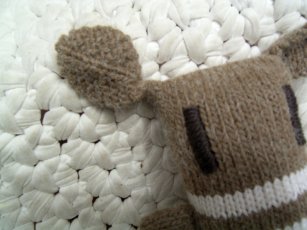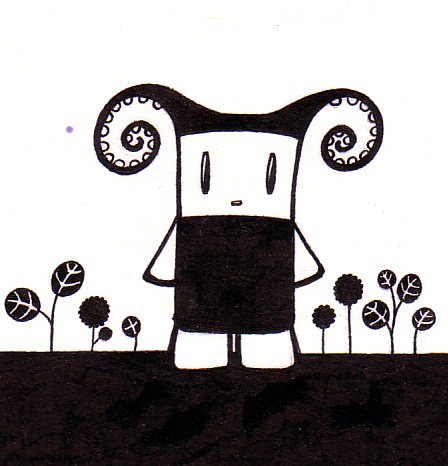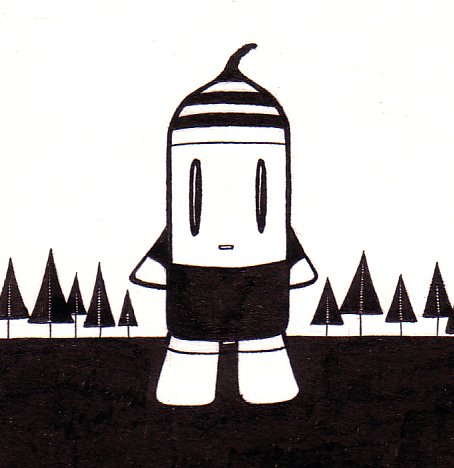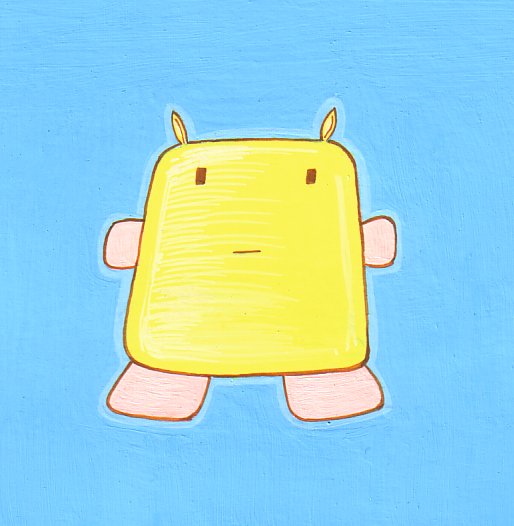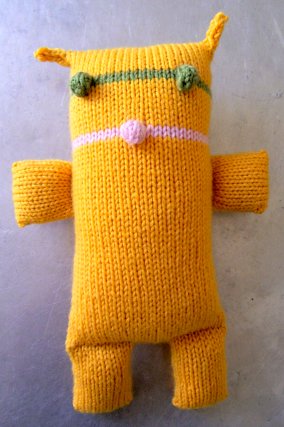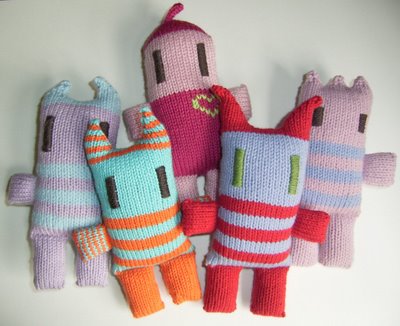
I've finally written up a pattern for these dolls - and made quite a few to check it. I hope everything makes sense!
Instructions are for knitting in the round with a single circular needle doubled up (the ‘magic loop’ technique). The doll’s body is cast on using the Turkish Cast-on. Other techniques used are i-cord, Kitchener stitch, and grafting.
The dolls are knitted with double-knitting weight yarn; I've used wool, cotton and acrylic. 2.5mm to 3mm needles should give the right gauge - firm and not too stretchy. One size down from the manufacturer's smallest recommended size should be about right. If using a combination of thicker and thinner yarn, favour the thinner yarn.
Body:
Cast on 40 sts, 20 sts per needle, using darker colour.
Knit 26 rounds.
The cast-on tail will be on the left-hand side of your knitting at the beginning of a round.
Break off yarn, and join lighter colour for "face".
Knit 20 rounds. Break off yarn and join darker colour.
Front and back of doll will be worked separately from here, working back and forth instead of in rounds. This is the "hat" part of the doll, and these instructions are for the "spike on head" version. Instructions for the other variations are below.
Back:
1st row: knit.
2nd row: purl.
3rd row: ssk, knit to last 2 sts, k2tog.
4th row: purl.
5th row: slipping first st, cast off 2 sts. Knit to end.
6th row: slipping first st, cast off 2 sts purlwise. Purl to end.
7th row: as 5th
8th row: as 6th
9th row: slipping first st, cast off 3 sts. Knit to end.
10th row: slipping first st, cast off 3 sts purlwise. Purl to end.
Cast off remaining 4 sts.
Front:
With right side of knitting facing, join darker yarn and knit as for back until 4 sts remain.
Next row: k1, k2tog, k1.
Switch to 2 dpns, and knit 4 rows i-cord.
Next row: sl1, k2tog, psso. Bind off.
Legs:
Using crochet hook and lighter colour, pull the end of the yarn through from the outside to the inside, at a corner. Secure on the inside.
Using circular needle, pick up 9 stitches along the bottom fold, starting at the corner and picking up through the bar between stitches.
Slide needle through these stitches so that they hang on the cable, and turn work. Pick up 9 stitches, working in the opposite direction, using the row just below the one previously used.
Knit 16 rounds.
Cast off all stitches, leaving a 10 cm tail.
Repeat for other leg, starting from the opposite corner.
Arms:
Find edge stitch at the top edge of the body (darker colour). Using crochet hook and lighter colour, pull the end of the yarn through from the outside to the inside at this point. Secure on the inside.
Using circular needle, pick up 9 stitches down the side of the body, using the loops of one side of a column of stitches. Pull the needle through these stitches so that they hang on the cable, and turn work. Pick up 9 stitches along the other side of the stitches previously used.
Knit 9 rounds.
Cast off all stitches, leaving a 10 cm tail.
Repeat on the opposite side of the body for the other arm.
Stripey variation:
Cast on with background (face) colour, knit 5 rounds.
Join contrast colour, without breaking off first colour.
Knit alternating bands of colour of 4 rounds each, for 20 rounds, ending with a round of the contrast colour. Break off contrast colour and continue with starting colour.
Knit 20 rounds.
Some options at this point are to continue with this colour; to break off this colour and join the contrast colour; or to join the contrast colour without breaking off the initial colour, and work in stripes.
Limbs can be knitted in the starting colour or the contrast colour. Arms are picked up from the top of the second-last band of colour, not from the border between the face and the body.
Lengths for limbs:
Legs – 19 rounds
Arms – 11 rounds
Head shape variations: (instructions start after the 20 rows of the face have been completed)
Pointy ears:
Knit 4 rounds.
Next round: k7, cast off next 6 sts, k13, cast off next 6 sts, k6. Adjust loops of circular needle so that stitches for one ear are all hanging together on the cable while the others are all together on a needle.
Next row: k7, turn.
Work back and forth.
Next row: p14
Next row: ssk, k to last 2 sts, k2tog.
Next row: purl
Repeat these last 2 rounds until 4 sts remain.
Next row: (RS) ssk, k2tog, pass 1st st over 2nd. Bind off, leaving long tail.
Rejoin yarn to remaining 14 sts with RS facing, k14. Turn, p14. Decrease as for first ear.
Pointy bits:
Each point is worked separately, as follows:
*k5, turn, p5, turn, ssk, k1, k2tog, turn, P3, turn, sl1, k2tog, psso, bind off.*
Rejoin yarn. Repeat from * to * until all stitches have been worked.
Making up:Embroider face and any other decorations.
Stuff doll, but not so firmly that the stuffing starts showing through the knitted fabric.
Sew up top of head using
Kitchener stitch.
Stuff and make up each limb separately: stuff until stuffing reaches top of tube, not too firmly. With 2mm or similar gauge dpns at the ready, undo the cast-off row, picking the live stitches up on the dpns, 9 per needle. Using the long tail left, graft the two sides of the tube together.
Alternatively, the cast-off edges can be Kitchener stitched together, but care has to be taken with the corners.
© Jesse Breytenbach 2006
For private, non-profit use only
I'll happily answer any questions via email (jezze-at-tiscali.co.za); every query helps me make the pattern better. And don't forget that for techniques like Turkish Cast-on and Magic Loop Google is your best friend!
I'd also love to see photos of any dolls made from this pattern, so email me if you finish one.
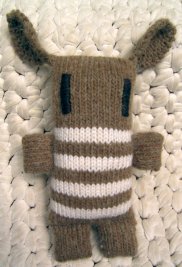
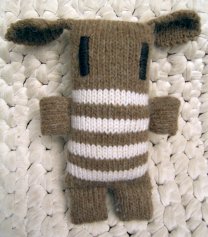
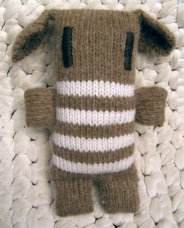 From the left: joy, dismay, sadness.